
Environmental Impact of Improper Document Disposal: The Overlooked Sustainability Crisis in Australia
National Shred – Secure On-Site Document Shredding & Recycling Across Australia
Many Australian businesses have digitised records and moved to the cloud — yet vast quantities of physical documents remain in filing cabinets and off-site storage. When these documents reach the end of their retention period, the environmental impact of improper document disposal becomes a serious hidden cost.
Throwing confidential files into general waste bins, unsecured skips, or regular landfill streams sends valuable paper fibre to decompose anaerobically. This process releases potent methane, wastes recycling opportunities, drives deforestation for virgin paper, and consumes excessive water and energy. Professional secure shredding services close the loop by destroying sensitive information while ensuring 100% of the shredded material is diverted into high-quality recycling streams.
At National Shred, we help businesses turn potential environmental liabilities into measurable sustainability wins — protecting both data and the planet.
What Is the Environmental Impact of Improper Document Disposal?
The environmental impact of improper document disposal extends far beyond simple landfill volume. Paper and cardboard waste that ends up in landfill breaks down without oxygen, producing methane (CH₄) — a greenhouse gas 25–28 times more potent than carbon dioxide (CO₂) over a 100-year period.
In Australia, solid waste management (including landfills) is a major contributor to national greenhouse gas emissions. Much of this comes from the anaerobic decay of organics and paper products. When paper is not recycled, the opportunity to displace virgin pulp production is also lost — a process that is highly energy- and water-intensive and contributes to habitat loss.
The Scale of Paper Waste in Australia: Latest Statistics
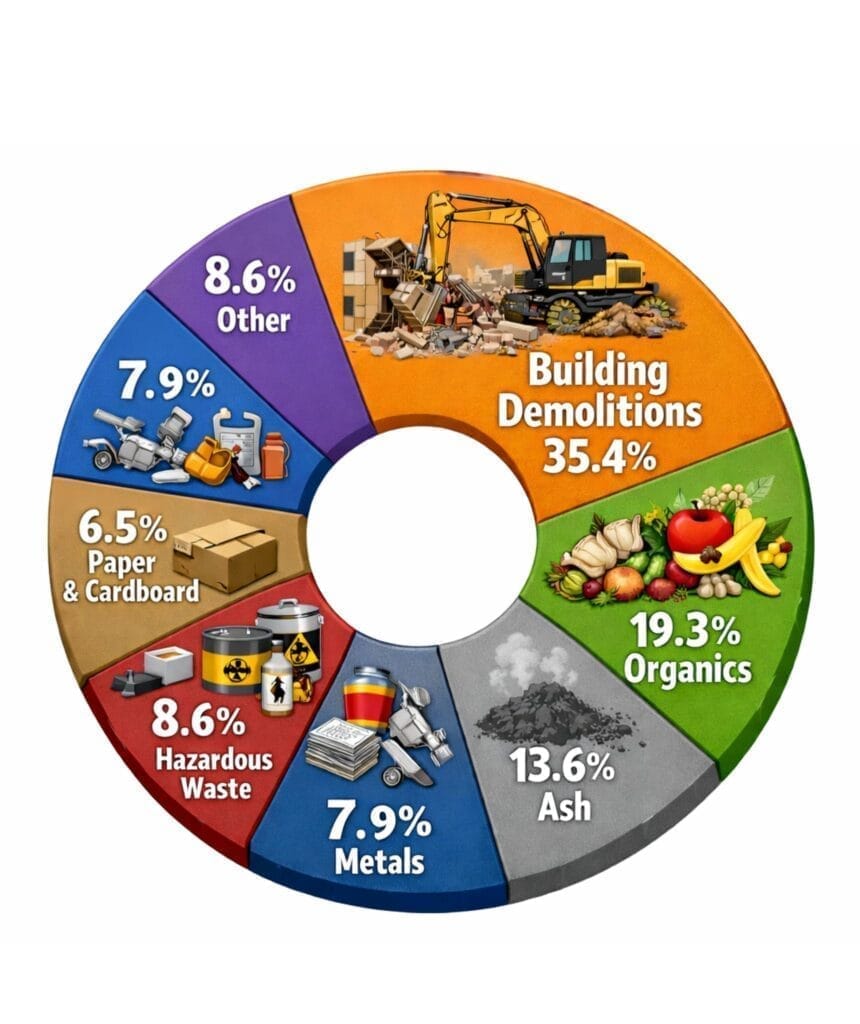
According to the National Waste and Resource Recovery Report 2024 released by the Department of Climate Change, Energy, the Environment and Water (DCCEEW), Australia generated an estimated 75.6 million tonnes (Mt) of headline waste in 2022–23. Of this:
- 4.9 Mt was paper and cardboard — equivalent to roughly 185–190 kg per capita.
- Approximately 61% of paper and cardboard waste came from the Commercial & Industrial (C&I) sector, which includes offices, finance, healthcare, legal, and government organisations.
- The overall resource recovery rate (recycling + reuse + energy recovery) reached 66% nationally, but the specific recovery rate for paper and cardboard sat at approximately 56% in recent years — meaning nearly half of all paper waste still ends up in landfill or other disposal pathways.
This represents millions of tonnes of paper fibre lost to landfill every year, directly worsening the environmental impact of improper document disposal.
Key Environmental Consequences of Improper Document Disposal
- Methane Emissions and Climate Change Landfill decomposition of paper produces significant methane. While some modern landfills capture landfill gas for energy, a large portion escapes. Diverting paper through professional shredding and recycling eliminates this anaerobic process and prevents associated CO₂-equivalent emissions.
- Deforestation and Habitat Loss Producing one tonne of virgin paper typically requires the equivalent of 17 mature trees and vast amounts of water (up to 26,500–31,000 litres). With Australia’s paper recycling rate below optimal levels, continued reliance on virgin fibre puts unnecessary pressure on forests.
- High Water and Energy Consumption Virgin paper manufacturing is one of the most resource-intensive industrial processes. Recycling one tonne of paper uses up to 70% less energy and 50% less water compared with virgin production, while also reducing air pollution significantly.
- Landfill Space Pressure and Transport Emissions Australian capitals, including Sydney, face growing landfill capacity challenges. Every tonne of paper sent to landfill consumes valuable space and generates additional transport-related emissions.
Comparison: Improper Disposal vs Professional Shredding + Recycling
| Impact Category | Improper Disposal (Landfill) | Professional Shredding + Recycling | Benefit |
|---|---|---|---|
| Trees per tonne | Requires ~17 new trees for virgin replacement | Saves ~17 trees | Major conservation |
| Energy use per tonne | Full virgin production energy | Up to 70% less energy | Significant savings |
| Water use per tonne | High (26,500+ litres for virgin) | ~50% less water | Major reduction |
| Methane emissions | High (anaerobic decay) | Eliminated – fibre recovered | Climate win |
| Landfill space | Consumes ~3–4 m³ per tonne | 100% diverted | Preserves capacity |
| Recycling recovery | 0% | Up to 98.5% fibre recovery | Circular economy |
How Professional On-Site Shredding Reduces the Environmental Impact of Improper Document Disposal
National Shred’s mobile on-site shredding trucks and secure console collection systems deliver cross-cut destruction (meeting or exceeding Australian security standards) followed by immediate transfer to certified recycling partners. This process ensures:
- Zero landfill from shredded paper
- Maximum fibre recovery — often 98%+ for new packaging, tissue, or office paper
- Full chain-of-custody and certificates of destruction for compliance and ESG reporting
- No risk of data breaches while achieving genuine environmental benefits
Unlike loose shredded paper (often rejected by kerbside recycling), our industrial process produces material perfectly suited for high-quality recycling.
Australian Regulations Driving Responsible Document Disposal
The Recycling and Waste Reduction Act 2020 and the National Waste Policy push Australia toward a circular economy. Businesses are increasingly expected to demonstrate sustainable waste practices through:
- ESG and sustainability reporting
- ISO 14001 environmental management systems
- Supply chain due diligence
While the Privacy Act 1988 (Australian Privacy Principles) requires secure destruction of personal information, leading organisations now align document disposal with broader environmental obligations under DCCEEW guidelines.
Real Business Benefits: Turning Waste into Sustainability Wins
Australian companies partnering with National Shred regularly report:
- Full diversion of archived documents from landfill
- Quantifiable carbon and resource savings for annual sustainability reports
- Reduced storage costs and lower insurance premiums
One Sydney financial services client recently shredded and recycled over 12 tonnes of legacy files during an office relocation — preventing the equivalent of approximately 200 trees from being harvested and avoiding landfill methane emissions comparable to several passenger vehicles’ annual output.
Building a Sustainable Document Destruction Protocol
Follow these steps to minimise the environmental impact of improper document disposal:
- Inventory all physical records and apply correct retention periods (e.g., ATO requires 5–7 years for most financial documents).
- Classify documents by sensitivity and environmental priority.
- Schedule regular secure console collections plus one-off bulk purges.
- Verify destruction and recycling with detailed reports.
- Report diversion metrics (tonnes recycled, trees saved, landfill space preserved) in your ESG dashboard.
Why Choose National Shred as Your Partner?
When selecting a shredding provider, look for:
- On-site mobile shredding with NAID-equivalent security standards
- Guaranteed 100% recycling of shredded material
- National coverage with strong Sydney / Kogarah operations
- Transparent pricing, instant online booking, and full compliance documentation
National Shred delivers all of the above. Our affordable console bins start from $110, with 24/7 online booking and a genuine commitment to both data security and environmental responsibility. Based in Kogarah, NSW, we serve Sydney, Melbourne, Brisbane, Perth, and regional Australia.
Ready to reduce the environmental impact of improper document disposal in your organisation?
Book your secure, sustainable shredding service today at nationalshred.com.au or call 1800 757 000.
Protect your sensitive information. Protect Australia’s environment. One responsibly shredded document at a time.
Frequently Asked Questions
Yes. Professional industrial shredding produces material that is readily accepted by recyclers, unlike loose shredded paper often rejected at kerbside.
No. The net outcome is strongly positive: avoided landfill methane, reduced virgin paper demand, and lower overall emissions compared with improper disposal.
We supply detailed certificates and recycling reports showing tonnes diverted, equivalent trees saved, water conserved, and landfill space preserved — perfect for ESG and sustainability reporting.
Absolutely. Our processes comply with Australian Privacy Principles while guaranteeing high recovery rates and zero landfill for shredded paper.
Contact National Shred 33 Phillips Road, Kogarah NSW 2217 Phone: 1800 757 000 Book online 24/7: nationalshred.com.au/order-now